On this page
Two people type the exact same question into the exact same AI assistant, and get different brands recommended back. Not because anyone’s rankings changed, but because the system asked different questions on their behalf. That idea is the spine of my talk “Context (not content) is king in AI search”, which I gave at SEOday in Aarhus and Berlin Campixx in 2026, and this is the full written version, updated to October 2026.
About this talk
- Events: SEOday (SearchDay), Aarhus, Denmark, 14 April 2026, and Berlin Campixx, Berlin, Germany, June 2026
- Video: Watch the Berlin Campixx talk on YouTube
- Slides: Berlin Campixx deck (PDF, final version) · SEOday deck (PDF)
- Audience: SEOs, content and brand marketers, in-house and agency
For years we’ve been told that content is king, and for years that was mostly true. Publish the best page, earn the links, rank, get the click. My argument in this talk is that the rule breaks the moment the system stops ranking answers and starts generating the questions. Content still matters enormously. It just isn’t the deciding variable any more. Context is.
This guide covers:
- The story I opened with: three people, one query, three different answers, and what the brand side of that looks like.
- How AI search actually works, as an eight-step pipeline, mechanism by mechanism: personalisation, query fan-out, memory, generation and citation, entities and schema, and agents. For each one, what carries over from traditional search, what’s different, and what it means for you.
- Tactics: the good, the bad and the ugly, including the uncomfortable truths about measurement.
- A framework for winning in both worlds: four pillars, plus the one most teams skip (user research).
- What to do this week, and over the next 90 days.
I’ve checked every claim about how these systems retrieve, ground and cite against the current documentation, patents and research, and linked it. Where something has moved on since I stood on stage, I say so.
Meet Sarah, James and Bob
I opened both talks with a story, because the mechanics land better when you can picture a person.
Sarah is a VP of Marketing with 12 years in B2B SaaS. Her team needs an AI writing tool and she’s been researching for weeks. Her inbox has newsletters from three vendors, her calendar has a demo booked with one of them, and she’s compared pricing on two.
James works at the same company. He’s a marketing coordinator, two years in. Same need, same query, but no vendor newsletters, no demos, no pricing tabs open. He subscribes to creator-led industry newsletters and learns from tutorials and videos.
They both ask their AI assistant: “What’s the best AI writing tool for a B2B marketing team?” Same query, same search intent, same consumer need, same company even. Yet worlds apart.
Sarah gets a specific, confident recommendation that echoes the comparison she read last month and the vendors already in her inbox. James gets a broader, more generic list, tilted towards cheaper and better-known options. Then Bob, the 20-year-old intern who overheard them in the breakroom, asks the same thing and gets pointed at free tiers. His role, history and circumstances are completely different, so his answer is too.
(Sarah, James and Bob are composite personas, and the answers on my slides were illustrations of the mechanism, not a logged experiment. Hold that thought, because a few months later someone did run the experiment.)

Here’s the line I wanted the room to leave with: different answers, not because the rankings changed, but because the questions the system asked on their behalf were different. Same input, different context, different fan-out, different retrieval, different response.
Your inbox is now a search signal
In May 2026, Garrett Sussman, Michael Tandoh and Cate Dombrowski at iPullRank published a controlled test of exactly this. They seeded brand signals into Gmail and Google Photos on Google accounts with Personal Intelligence switched on, then analysed 1,922 AI Mode responses across eight product categories, from coffee machines to SEO agencies. (On my Campixx slide I said 1,922 queries; it’s responses.)
- Seeded brands were 46 percentage points more likely to appear than in the control account. Appearance rose from 23.9% to 66.8% in the connected account, while the control drifted from 21.9% to 18.9%.
- Brands seeded through Gmail appeared 53.6% of the time, against 10.5% for Photos.
- Top-three placement improved by about 23 percentage points.
The authors are careful about the limits: it covers Personal Intelligence after a user opts in, not default AI Mode, with a small number of accounts over a short window, and no view into Google’s internal ranking systems. Still, the direction is hard to argue with. Sarah’s newsletter subscriptions plausibly shape her AI recommendations.
This has also stopped being a niche feature. Google launched Personal Intelligence in the Gemini app in January 2026 for paying US subscribers and extended it to free US personal accounts in March. A month after SEOday, at I/O in May, it rolled it out in AI Mode to nearly 200 countries and territories, with Gmail and Photos connectable and Calendar announced as coming. It’s opt-in, but the audience that can opt in is now most of Google’s.
Now think about it from the brand side
In the talk I put two kinds of brand next to each other.
The authority is the established knowledge leader. It has invested in content for years: comprehensive guides, whitepapers, thought leadership, rankings for hundreds of queries, E-E-A-T everywhere. The AI system uses its content to understand the category, and then recommends someone else to Sarah. Its content was essential to the answer, but it wasn’t cited or credited. Used for context, not for credit.
The specialist is the focused challenger. Smaller, laser-focused, every page built around clear entities and specific use cases, schema connecting brand to people to products to use cases. Its newsletter is in Sarah’s inbox, and it tells the same story on its site, LinkedIn and Wikidata. It matches Sarah’s context, so it gets named, cited and linked in her answer.
“Content is king” worked when the system ranked answers. It breaks when the system generates the questions.
Lazarina Stoy, SEOday and Berlin Campixx 2026
Same ingredients, different recipe
None of this is new technology, and I think that’s important to say out loud in a room full of SEOs who’ve been told everything they know is dead. AI search is built from the same building blocks we’ve worked with for a decade: natural language processing, embeddings, knowledge graphs, retrieval and ranking. They’ve been reassembled in a different order.

Traditional search goes query, index lookup, rank, results. Personalisation happens at the ranking step: same ten links, slightly different order. AI search goes query, context and memory, fan-out, retrieval, reasoning, synthesis. Personalisation happens before retrieval, at the point where the system decides what to look for. That’s the whole talk in one diagram.
How AI search works: the eight-step pipeline
The middle of the talk walks through the pipeline one mechanism at a time. I pieced it together from Google’s patents and announcements, the retrieval-augmented generation research, and platform documentation, and wrote it up in more depth for iPullRank in pieces on entity recognition, fan-out and intent drift and personalised fan-out with memory and context.

- Query reception and routing. The system parses the input (text, voice or image), judges its complexity and decides how to handle it. Google’s application on search with stateful chat describes classifying a query into response types, such as needing a summary, needing a clarifying question or not needing intervention, and routing to specialised models. “Capital of Germany” is a Knowledge Graph lookup. “Bluetooth headphones comfortable for runners with long battery life” triggers a full research operation.
- User state retrieval. Before it generates a single sub-query, the system gathers what it knows about you: prior queries and session history, location, device and time, stored preferences, saved memories and, where connected, apps like Gmail or Calendar.
- Semantic fingerprinting. That context gets turned into something a model can use. Google’s patent application on user embedding models for personalisation describes compressing a user’s history into compact embeddings fed to a language model as “soft prompts”. Two people asking the same thing arrive with different representations.
- Query fan-out. One query becomes many synthetic sub-queries, shaped by that context.
- Retrieval. The sub-queries run in parallel across the web index and other sources, at passage level.
- Re-ranking and entity recognition. Candidates are filtered and reordered, increasingly by language models themselves (see Google’s application on pairwise ranking prompting, where an LLM compares passages two at a time).
- Reasoning and synthesis. The model composes an answer grounded in the retrieved passages.
- Citation and output. Some of those passages get credited with a link. Many don’t.
I’d add one honest caveat that I also made on stage: no platform publishes its full pipeline, and patents describe what a company has protected, not necessarily what it runs today. What we can verify is that Google itself describes AI Mode as issuing multiple related searches concurrently across subtopics and multiple data sources, and OpenAI and Perplexity document the retrieval-then-cite pattern in their own developer docs. The rest is informed inference, and I’ll flag it as such.
If you want the funnel view of where content gets eliminated along the way, MLforSEO’s five-stage retrieval funnel is the companion read.
Mechanism 1: personalisation moves upstream
Personalisation to a degree we’ve never seen before. I split the context an AI system can draw on into three layers, and each layer down is more invisible to you, produces a more personalised fan-out, and is harder to compete against.

- Explicit context: what the user tells the system directly. Saved preferences, stated intent, custom instructions.
- Implicit context: what the system infers. Search history, session patterns, click behaviour.
- Ecosystem context: connected services. Gmail, Photos, Calendar, Teams, newsletters, browsing. The deepest layer.
Not every platform knows the same amount about you
On stage I showed a spectrum of inference depth, from Perplexity (shallow, session-based) to Copilot (deepest, with the whole Microsoft 365 graph). The order still broadly holds, but the shallow end has filled in fast since April, so here’s the October 2026 version:
| Platform | What it can draw on (October 2026) | Since the talk |
|---|---|---|
| Perplexity | Memory across threads, models and search modes, which users can view, delete or switch off | No longer just session context; memory launched in November 2025 |
| Claude | Memory of past conversations plus chat search (release notes) | Memory opened to all users, including free, in March 2026 |
| ChatGPT | Saved memories plus reference to chat history; memory can rewrite web searches | Memory rebuilt in June 2026 to update itself and revise time-sensitive facts (release notes) |
| Gemini and AI Mode | Personal Intelligence: Gmail, Photos, YouTube and Search history in Gemini; Gmail and Photos in AI Mode | Expanded globally in AI Mode in May 2026 |
| Microsoft 365 Copilot | Emails, files, meetings, calendars and chats via Microsoft Graph, within the user’s permissions | Graph grounding is a premium-licence feature; the basic chat tier doesn’t get it |
The implication hasn’t changed: the more a user interacts with an AI system, the more specific, and the more invisible to you, the fan-out becomes.
Google did this long before AI search
Here’s the part that should reassure the traditional SEOs in the room. Google has personalised results using behavioural signals for twenty years, and the patent trail shows it:
- 2003: Information retrieval based on historical data, which uses changes over time, including user behaviour, to judge freshness.
- 2004: Modulating search relevancy using pointer activity: mouse hover as a relevance signal.
- 2006: Modifying search result ranking based on implicit user feedback, the long-click patent. (My slide dated it 2011; the priority date is 2006 and it was granted in 2014.)
- 2007: Demoting personalised search results based on personal information.
- 2023 onwards: user embedding models, turning that same context into embeddings for language models.
The US antitrust case against Google filled in the rest. Trial evidence described Navboost, which remembers clicks on queries over roughly 13 months, and Glue, which combines clicks, hovers, scrolls and swipes, and the September 2025 remedies ruling ordered Google to share some of its index and interaction data with qualified competitors. Pandu Nayak also testified that Google’s newer machine-learning systems rely on much less user data than the older ones. That’s the bridge I drew in the talk: the behavioural signals that powered traditional personalisation now feed the models that personalise AI search.
| Traditional search | AI search | |
|---|---|---|
| What’s personalised | The ranking of results | The questions that generate results |
| Signals | Clicks, dwell, location, device, cohort | All of those, plus memory, embeddings and cross-product data |
| When it happens | After retrieval (re-ranking) | Before retrieval (query generation) |
| What the user sees | Same ten links, different order | A different response per user |
Same signals. More data. Different application point.
Mechanism 2: query fan-out
This is the mechanism that most changes our job. The system expands a single query into many synthetic sub-queries, each targeting a different facet of intent and shaped by the user’s context. Google says AI Mode works by breaking down your question into subtopics and running them simultaneously, and that its Deep Search mode can issue hundreds of searches to produce a cited report. Google’s own documentation for site owners now names query fan-out explicitly.
Where do the sub-queries come from? Google’s patent on generating query variants using a trained generative model lists the types, and I put them on a slide because they’re a surprisingly practical content checklist:

- Equivalent: alternative phrasing for the same question.
- Follow-up: the logical next question.
- Generalisation: a broader version.
- Specification: a narrower, more detailed version.
- Canonicalisation: standardised phrasing.
- Language translation: the same need in another language, so multilingual content can be retrieved.
- Entailment: questions implied by, or logically following from, the original.
- Clarification: a question back to the user to confirm intent.
Fan-out also isn’t one pass. The same patent describes a generative model producing variants, the search system returning results, and a separate control model judging them, with the generator refined through reinforcement learning. It keeps going or stops depending on whether useful responses come back.

Since I gave this talk, I’ve cut one detail from this slide. I’d shown the loop stopping after “around 20 iterations”. Re-reading the patent, there’s no such limit: it gives illustrative counts of variants (more than 5, 10 or 15) and stops dynamically on quality. Better to be precise.
Entities steer the expansion
The system doesn’t just expand words, it expands entities. Ask for the “best SUV” and the expansion reaches for specific product entities and their attributes (models, safety ratings, range, cargo space) via Knowledge Graph relationships, not a synonym list. Complex queries get decomposed the same way, with each step anchored to an entity:

This is why I keep banging the drum for the entity-attribute-variable (EAV) model: the boundaries of a good passage line up with an entity and one of its attributes. MLforSEO has a good primer on how entities power query fan-out, and another on synthetic queries, the queries no human ever typed.
Fan-out can skew intent
There’s a darker side, which I covered in my iPullRank piece on how fan-out skews intent. Follow-up, generalisation and entailment variants can drift away from the user’s narrow intent, because the model moves through neighbouring concepts in vector space, not keyword matches. Google’s thematic search patent describes generating themes from the documents that come back and organising results around them. In traditional search the user decides whether to wander into an adjacent intent. In AI search, the system decides for them, and authentic niche content can get swapped for aggregated “top picks”.
Parallel retrieval, at passage level

The sub-queries fire across several sources at once: the web index, the Knowledge Graph, the Shopping Graph, vertical databases. Retrieval is usually hybrid. Perplexity’s own write-up of its search infrastructure describes querying its index both lexically and semantically, merging the results into one candidate set, and treating sections and spans of documents as first-class units. That index handles around 200 million queries a day.
Back to Sarah and James. Sarah’s fan-out reaches for enterprise integration, a head-to-head between the two vendors she’s already seen, team collaboration with an API, and brand-voice pricing. James’s reaches for “best tools 2026”, free generators and small-team budgets. Same query, different consideration sets.
| Traditional search | AI search | |
|---|---|---|
| Expansion | “Did you mean?” and related searches | Many synthetic sub-queries |
| Who decides | The user refines their own query | The system generates questions on the user’s behalf |
| Entity role | Synonym matching | Knowledge-Graph-anchored entity expansion |
| Scale | One results page per query | Parallel retrieval across web, Knowledge Graph and shopping data |
Implication: your content either fits the personalised fan-out, or it doesn’t exist in that person’s consideration set.
If you want to build keyword research around this (entities, attributes, intent variants and the questions systems generate) that’s exactly what my Semantic ML-enabled Keyword Research course in the MLforSEO Academy teaches.
Mechanism 3: memory as a persistence layer
Memory is what makes AI personalisation fundamentally different from cookie-based session personalisation. AI systems keep state across sessions: saved memories, chat patterns, stored preferences. And memory doesn’t just filter results. It rewrites the question before retrieval begins.
OpenAI says this in plain words. Its memory FAQ gives the example of a user ChatGPT knows is vegan and lives in San Francisco: asked for restaurants nearby they’d like, ChatGPT can search for “good vegan restaurants, San Francisco”. Swap vegan for “needs an API” and San Francisco for “enterprise team”, and you have Sarah. Every future question she asks about tools carries those facts with it.
MLforSEO has a short explainer on query context and session context if you want the traditional-search version of the same idea first.
Implication: traditional search shows you options. AI search decides for you.
Mechanism 4: generation and citation, where used doesn’t mean cited
Underneath every AI search product is some form of retrieval-augmented generation. The idea goes back to Lewis et al. (2020): retrieve relevant documents, then generate an answer conditioned on them, to reduce hallucination. Later research added the moves you can now see in production: decomposing multi-hop queries into sub-questions (RQ-RAG), fusing results from several reformulated queries (RAG-Fusion), adapting retrieval depth to query complexity (Adaptive-RAG), and checking retrieved context before using it (Corrective RAG, by Yan, Gu, Zhu and Ling; my SearchDay reference list credited the wrong authors, now fixed).
| Traditional search | AI search | |
|---|---|---|
| Unit of competition | The page | The passage |
| Output | Ten blue links; the user decides | A synthesised answer; the system decides |
| Citation | Ranking equals visibility | Used doesn’t mean cited; grounding isn’t credit |
| Quality bar | Better than competitors | Good enough to ground a claim against |
Retrieval is passage-level
Documents get chunked before they’re retrieved. Google’s own documentation for its enterprise search product (formerly Vertex AI Search) describes layout-aware chunking, where every chunk comes from one layout element such as a heading or a list, chunks run to a few hundred tokens, and ancestor headings can be attached so a chunk keeps its context. Your paragraph, not your page, is the unit of competition. MLforSEO’s The chunk, not the page goes deep on writing for this.
Grounding is not credit
The citation step is where the authority from my story loses out. Google’s patent on generative summaries for search results describes “linkifying” a generated summary by comparing an embedding of each part of the summary against embeddings of the source documents. If a source is close enough, it verifies that portion and gets the link. If it isn’t, it doesn’t, even if it was retrieved. Gemini’s grounding API exposes the same shape publicly: grounding metadata maps individual text segments of an answer to the sources that support them. And OpenAI’s web search documentation distinguishes the full list of sources the model consulted from the smaller set of inline citations it shows.
The research backs this up:
- An AirOps analysis published in March 2026 found ChatGPT cited only 15% of the 548,534 pages it retrieved. Fan-out turned 15,000 prompts into more than 43,000 searches, and about a third of cited pages showed up only in the results for those fan-out queries.
- Ahrefs found that only 37.9% of AI Overview citations came from the top 10 organic results for the original query (March 2026), down from its earlier estimate, a change it partly attributes to fan-out.
- Even what does get cited isn’t always faithful. Liu, Zhang and Liang (2023) found only 51.5% of sentences from generative search engines were fully supported by their citations, and the Tow Center’s 2025 comparison of eight AI search tools found them wrong more than 60% of the time when asked to identify the source of a news excerpt.
So the uncomfortable truth from the talk stands: your content might be used to inform a response and never be cited. Used for context, not credited. MLforSEO’s Indexed is not selected is the best explanation I know of why ranking is the wrong mental model here: the question isn’t whether you’re indexed or even ranked, it’s whether you’re selected.
Mechanism 5: entities, schema and technical branding
Entities aren’t new. Google’s Knowledge Graph launched in 2012. But in AI search, entities are the unit of understanding at every stage of the pipeline.
| Pipeline stage | What entities do |
|---|---|
| Query understanding | Detect the entities in the query and shape its context embedding |
| Personalisation | Map the user’s attributes to clusters in the knowledge graph |
| Fan-out | Crosswalk references to broader and narrower equivalents |
| Retrieval | Filter by entity type and canonical IDs |
| Re-ranking | Bias results using type constraints and knowledge-graph proximity |
| Synthesis | Ground the generated answer in entity-checked facts |
| Citation | Match generated text to source passages |
Three systems do the work together. Named entity recognition labels the people, organisations, products and places in text. Entity linking maps each mention to a canonical ID (a Wikidata Q-ID or a Google Knowledge Graph MID), which is how “Jordan” the person is told apart from the country. Knowledge graphs supply the relationships. If you’ve never run your own pages through an entity extractor, start with MLforSEO’s guide to what entity extraction is and where it fits in SEO. It’s the closest you’ll get to seeing your text the way these systems do.
AI search systems understand things and relationships through repeated signals. Not strings.
Schema: the honest picture
On stage I called schema “still essential, with caveats”, and said research shows it gets flattened, partly dropped or processed like any other text. The evidence has got sharper since, so here’s the honest picture in October 2026:
- Google’s AI features documentation says there’s no special schema.org markup you need for AI Overviews or AI Mode, and that structured data should match what’s visible on the page.
- Microsoft’s Fabrice Canel said at SMX Munich in March 2025 that schema markup helps Microsoft’s LLMs understand content.
- When AI chatbots fetch a page directly, searchVIU found they don’t read data that exists only in JSON-LD.
- Ahrefs ran a controlled before-and-after test on pages that added JSON-LD and found no major uplift in AI citations on any platform (May 2026).
So I’d now put it more precisely: schema is infrastructure, not a ranking trick, and not a citation trick either. Its job is to make your entities unambiguous to the search indexes and knowledge graphs that AI search draws on. What matters most is the connective tissue: @id linking between entities on your site, sameAs links to Wikidata, LinkedIn and your Business Profile, and relationships declared in both directions. Above all, it has to be consistent, which is why MLforSEO argues that consistency beats completeness, and that trust isn’t a schema field you can simply declare.
Technical branding and co-citation
Technical branding means making sure machines identify your brand correctly and consistently: one entity name everywhere, canonical IDs linking every mention, and explicit relationships between your entities. In the talk I called the process the BRIDGE framework: blueprint your entity landscape and find the gaps, define relationships and hierarchies with @id, implement structured data across your pages, distribute your entity presence across platforms like LinkedIn, Wikidata and your Business Profile, then grow the network over time.
Co-citation is the other half. LLMs learn authority through association: when your brand keeps appearing alongside established names in comparisons, alternatives and category content, they infer you belong in that neighbourhood. Ahrefs’ study of 75,000 brands found branded web mentions correlated more strongly with AI Overview visibility (0.664) than backlinks or Domain Rating did. That’s correlation, not causation, and only for AI Overviews, but it fits. MLforSEO has a full piece on how LLMs co-cite.
Mechanism 6: agents, the next layer
Agents don’t just answer, they act. Bigger memory, more context about preferences, and ruthless filtering of whatever you don’t need. An agent shopping for Sarah won’t show her ten options. It will recommend the one that fits her context, and possibly buy it. Agents compress awareness, consideration and purchase into one interaction, and if you’re not in the agent’s consideration set, you don’t exist.
Since I gave this talk, the protocol layer I sketched on the slide (MCP, ACP, Agent Protocol) has consolidated quickly:
- MCP, Anthropic’s Model Context Protocol, became a founding project of the Linux Foundation’s Agentic AI Foundation in December 2025.
- A2A, Google’s agent-to-agent protocol, absorbed IBM’s ACP in August 2025.
- Commerce: OpenAI and Stripe’s Agentic Commerce Protocol powers checkout inside ChatGPT, Google’s AP2 handles agent payments, and its Universal Commerce Protocol, built with Shopify, Etsy, Wayfair, Target and Walmart, powers checkout in AI Mode and Gemini.
Agents don’t browse. They decide. MLforSEO’s Your audience is no longer only human picks this up from there.
Tactics: the good, the bad and the ugly
The good
Structured comparisons. Comparison pages work in both worlds. Traditional SEO captures “X vs Y” keywords and featured snippets; LLMs lean on comparison content when answering product questions. The good ones explicitly position the product against named competitors with clear entity markup, specific attributes and context-specific positioning (“for enterprise teams”, “for agencies”), and they’re honest. In the talk I showed a real vendor comparison page that did this well: a capability table, a clear use-case split and an FAQ.
Cross-platform entity presence. I called this the Trustpilot effect. A Trustpilot-commissioned Seer Interactive study of around 800,000 AI responses (May 2026) found that brands without an active Trustpilot profile showed up in a median 1% of answers that cited Trustpilot, against 53.5% for brands with even a minimal profile, and around 75% or more once they had 80-plus reviews and responded regularly. Bear in mind who paid for it and how narrowly it’s defined. The wider lesson is the one I made on stage: your site plus LinkedIn plus Wikidata plus your Business Profile plus review platforms makes a multi-source entity signal, with one canonical name everywhere, and each platform reinforces the others.
Entity networks. Upgrade topic clusters into entity-connected networks. The old model is a pillar page and supporting articles organised by keyword. The new one is entity hubs and supporting content linked by @id-connected schema (Person to Organisation to Product to Concept), with every paragraph independently citable. The old model works for traditional SEO. The new one works for both. See MLforSEO on entity hubs over keyword landing pages.
The bad
Thin programmatic content. Mass-producing pages that target niche angles with manufactured co-citation, no real expertise, low entity salience and no author attribution. It fails in AI search for the same reasons it fails in traditional search. Google’s helpful content system became part of its core ranking systems in March 2024, and its spam policies name scaled content abuse outright. Kevin Indig put the off-site version neatly: generic off-property authority leaks budget, because the sources AI trusts are topic-specific.
How to fix it:
- Genuine comparisons and storytelling. Replace thin pages with multi-format content: service pages, tools, videos, testimonials, documentation, topic hubs.
- Real personas. Ruthless audience definition. Talk to your CRM team, reverse-engineer conversion pathways, know your users’ context.
- Cross-platform adaptation. The same story across site, social, email and community. Not duplication, adaptation for each channel.
The ugly
Ugly truth #1: the segment gap. Rarely, if ever, is a top performer totally invisible in AI search. But it can be invisible to the niche segment that’s growing fastest: the people shifting to AI search. That segment is still small next to Google. Datos and SparkToro found AI tools still accounted for under 2% of US desktop search activity in Q1 2026 (1.65%, up from 1.31% a year earlier), while Similarweb data shows generative AI visits up 70% year on year. Your rank tracker still shows #1. The fastest-growing slice of your audience can’t find you.
Ugly truth #2: rank tracking and prompt tracking are both broken. Rank trackers can’t see AI visibility, and prompt tracking isn’t much better, because AI search is stochastic. SparkToro’s January 2026 study ran the same prompts thousands of times across ChatGPT, Claude and Google’s AI and found less than a 1-in-100 chance of getting the same list of brands twice, and less than 1-in-1,000 of the same order. What was meaningful was how often a brand appeared across many runs. So there is no stable query to rank for. Your visibility is a distribution across user contexts, not a position. (MLforSEO: Your rank tracker is lying to you about AI search.)
Ugly truth #3: the decision happens before the click. In Kevin Indig’s study of high-stakes purchases in AI Mode (April 2026), 74% of final shortlists came directly from the AI’s output, and most AI Mode users clicked nothing at all. If you’re only mentioned as background, you’re not on the shortlist.
A framework for both worlds: omnichannel visibility
So what do you do to be one of the brands that shows up? My answer is not to choose between traditional SEO and AI search, and to let context strengthen both. At SEOday I framed it as four pillars that work for both at once.

1. Entity clarity
Make your brand, products and concepts unambiguous to machines. Define clear entity names and keep them consistent across pages, titles, headings and alt text. Implement schema with sameAs links and @id. Disambiguate in the first paragraph, because models resolve ambiguity early. A quick checklist from the deck:
- Run your top ten pages through an entity API. Is your primary entity the most salient one on each page, and is it typed correctly (a product, not “other”)?
- Do your primary entities have Knowledge Graph IDs?
- Is naming consistent everywhere (not “Acme Corp”, “ACME” and “Acme”)?
- Does every key entity have a dedicated hub page?
- Are relationships bidirectional (Person worksFor Organisation, and Organisation employee Person)?
- Which entities do your competitors cover that you don’t?
Since I gave this talk, two tool notes. If you use Google Cloud’s Natural Language API for this, stick with v1: the newer v2 drops the salience score. And Google describes its Knowledge Graph Search API as not suitable for production-critical use, so treat it as a spot-check, not a pipeline. My Introduction to Machine Learning for SEOs course in the MLforSEO Academy walks through entity extraction with these APIs step by step.
2. Contextual depth
Go beyond keyword coverage. Build topic-entity networks with explicit relationships (isPartOf, about, knowsAbout). Cover the variants fan-out generates: synonyms, intent modifiers, brand-focused, location and industry, question forms, pain points. Write passage-level, atomic facts anchored to entities. And design for information gain: original data, specific frameworks and real examples get retrieved over generic coverage.
There’s research behind the passage-level advice. The Generative Engine Optimization paper (Aggarwal et al., KDD 2024) found that adding citations, quotations and statistics improved a source’s visibility in generative answers by up to 40%, while keyword stuffing did little or nothing.
3. Source authority
Be the source LLMs trust. E-E-A-T still sets the bar: author attribution, expert bylines, About pages and trust signals. Build co-citation by getting your entities mentioned alongside established authorities. Create citation-worthy answers: direct, specific, solving a real problem, attributed to a named person. And engineer how your brand is described:

- Core identity: five to seven canonical sentences that define your brand, used verbatim across your About page, LinkedIn, Wikidata, press releases, guest bios and podcast intros.
- Attributes: eight to ten attributes you want associated with your brand. For each, one deep article, three pieces of social proof, five third-party citations and two comparison pieces.
- Context-specific positioning: because models answer differently by context, write positioning for each one: versus enterprise, versus start-ups, specific use cases, budget-conscious, security-focused.
4. Omnichannel consistency
Strengthen the message across channels without fragmenting it. One canonical name everywhere (“Dr Emma Chen” on every page, not “Emma Chen PhD” or “E. Chen”). Identical properties across sources: founding dates, addresses, URLs, one source of truth. Then reach your audience in every channel an AI system might pull from. MLforSEO calls this the LLM-era NAP.
| Touchpoint | What to do |
|---|---|
| Your website | Entity-rich, schema-marked, passage-level content |
| Newsletter and email | Becomes a Gmail signal for AI recommendations where users connect it |
| Posts, newsletters, company page, with an exact name match | |
| Wikidata and Business Profile | Claimed, complete, linked with sameAs |
| Reddit, X and forums | Genuine participation and natural mentions |
| Events | Speaking, sponsoring and community presence, which builds co-citation |
| Documentation and tools | Unique resources that earn links and citations |
Is omnichannel different from what people have been doing? Perhaps not. But there’s now a layer of AI-enabled synthesis sitting on top of it, so it had all better be written and optimised for that too.
The fourth pillar: user research
By Campixx I’d added a pillar underneath the others, because everything above depends on it. Know your audience with the granularity AI systems require.
- Talk to your CRM team. Who converts, and why?
- Map those conversion pathways to AI search contexts: interests, history, intent.
- Create content for the fan-out queries those contexts would generate.
- Reflect each segment across content, website and social, and speak to it directly. The system matches specificity.
The practical end point is what I called building your audience’s search twins: synthetic accounts and personas that mirror your core segments, seeded with the context they’d plausibly have, so you can test prompts the way they’d experience them and monitor what gets recommended. It’s how the iPullRank inbox experiment worked, and if you want to start somewhere, Kevin Indig’s guide to synthetic personas for prompt tracking and iPullRank’s persona guide chapter on AI personalisation are good next reads. Persona research has never mattered more.
How to measure it
| Metric | How to measure | Target |
|---|---|---|
| Entity coverage | Share of priority entities with a hub and 3+ supporting pages | Above 80% |
| Schema coverage | Share of pages with correct, validated markup | Above 80% |
| Entity consistency | Same name and properties across all platforms | 100% |
| Relationship density | Average schema relationships per entity | More than 3 |
| AI visibility rate | How often you appear across many repeated runs of 10+ industry prompts on several platforms, ideally from persona accounts | Track the trend |
| Grounding rate | Share of key prompts where your content is used or cited | Track the trend |
I’ve changed one row since the talk. I used to say “test 10 queries weekly on three platforms”. Given how much answers vary from run to run, a weekly spot-check is noise. Run each prompt many times and track how often you appear, not where.
What to do this week
- Audit your top ten pages with an entity API. Are your primary entities salient, correctly typed and linked to Knowledge Graph IDs?
- Check your schema for @id and sameAs. Are entities connected in both directions? Do sameAs links point to Wikidata, LinkedIn and your Business Profile?
- Set an AI visibility baseline. Run ten industry prompts repeatedly on ChatGPT, Claude, Perplexity and AI Mode. Which brands appear? Are you mentioned? Which entities come up most?
- Write one passage-level answer. Pick your most important question and write a paragraph that answers it directly, with specific data, attributed to a named person.
- Align one entity across three platforms. Your brand or your founder: the exact same name on your site, LinkedIn and Wikidata, with sameAs links. It takes about 30 minutes.
The 30-60-90 day roadmap
| Days 1–30: foundation | Days 31–60: authority | Days 61–90: scale |
|---|---|---|
| Entity audit on top pages | First entity hub (2,000+ words, attributed) | Expand to Tier 2 entities: team, products, methodologies |
| Deploy Tier 1 schema: organisation, founder, main products | Five supporting pieces per hub | Roll out the three-layer brand narrative |
| Establish LinkedIn, Wikidata and Business Profile presence | Bidirectional @id relationships | Co-citation content: comparisons, alternatives |
| Set the AI visibility baseline | First competitive entity-gap analysis | Re-measure against the baseline |
Mindset shifts
| From | To |
|---|---|
| What keywords should I target? | What entities should I be associated with? |
| How do I rank for this query? | How do I get included in the fan-out for this topic? |
| How do I optimise this page? | How do I make each paragraph independently citable? |
| Who are my SERP competitors? | Whose content gets cited for my users’ contexts? |
| Content is king | Context is king |
What won’t change
I closed both talks the same way, because the playbook isn’t being rewritten. It’s being expanded.
- Quality content wins. Models filter out promotional fluff just like people do.
- Trust is built through consistency, accuracy and genuine expertise, across both channels.
- Understanding your audience matters more than ever, now that the machines are trying to understand them too.
- The best answer for the user will surface. Make sure that’s you.
Context doesn’t replace content. It makes your content’s message stronger, everywhere. Welcome to the era where context is king.
The slides from both events are free to download: the Berlin Campixx version (the final one, with the Sarah and James story and the tactics section) and the SEOday version (with the deeper mechanics, the framework and the reference list). Thank you to the SEOday and Campixx teams and to everyone who came up afterwards with questions; a lot of this write-up is shaped by them.
Want me to give this talk at your event? Book me to speak.
Frequently asked questions
What does “context is king” mean in AI search?
It means the deciding factor in whether your brand appears is increasingly the user’s context (their history, memory, connected apps and situation), because AI systems use that context to generate the sub-queries they retrieve for. Great content is still necessary, but it only gets considered if it fits the questions the system asks on that user’s behalf.
What is query fan-out?
Query fan-out is when an AI search system expands one query into many related sub-queries, runs them in parallel across sources, and combines the results into one answer. Google describes AI Mode as working this way, and its Deep Search mode can issue hundreds of searches for a single request. Google’s query-variants patent describes eight types of variant, from equivalents and follow-ups to clarifications.
Does schema markup help you get cited by ChatGPT or AI Overviews?
Not directly, on current evidence. Google says no special schema is needed for its AI features, chatbots fetching a page don’t read JSON-LD-only data, and a controlled Ahrefs test found no major citation uplift from adding schema. It’s still worth doing well, because it helps search engines and knowledge graphs identify your entities, and that understanding feeds AI search. Treat it as infrastructure, and prioritise consistency and @id/sameAs connections over filling in every property.
Can you track rankings in AI search?
Not in the traditional sense. Answers vary from run to run and from user to user, so there’s no stable position to track. What you can measure is how often your brand appears across many repeated runs of a prompt set, ideally from accounts that mirror your real audience segments, plus how often your content is cited.
Does personalisation mean smaller brands can beat bigger ones in AI search?
Sometimes, yes. Because the system builds a consideration set around each user’s context, a focused brand that communicates a specific offer clearly, with consistent entities across platforms, can be recommended over a bigger brand whose content was used to understand the category but didn’t match that user’s needs. Links and authority still matter. They’re just less decisive than being the right answer for that person.
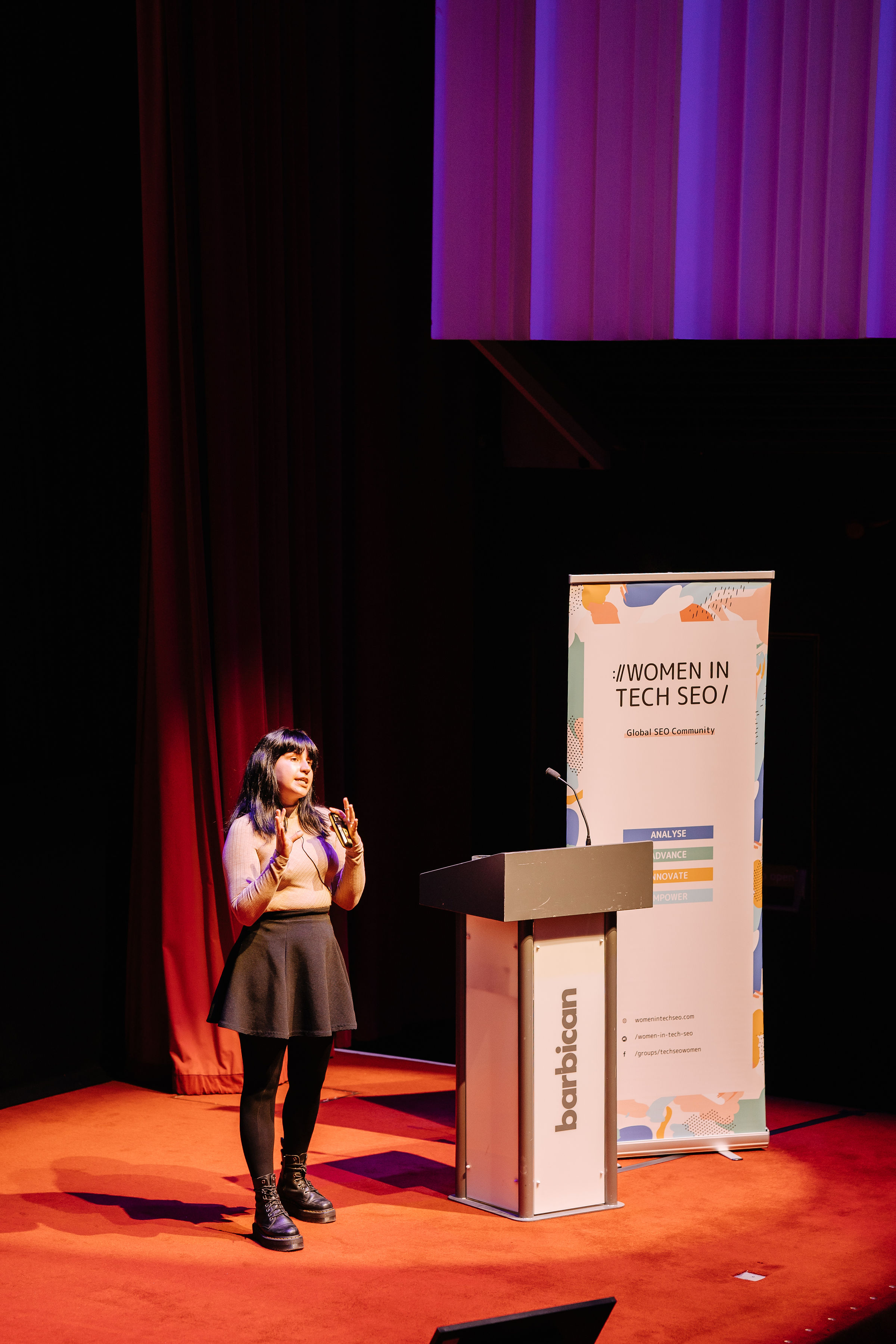
Written by Lazarina Stoy
Organic growth and AI automation consultant, speaker, and founder of MLforSEO and Data Studio for Marketers. I help marketing teams use AI and automation in ways that are practical, sustainable and scalable.