On this page
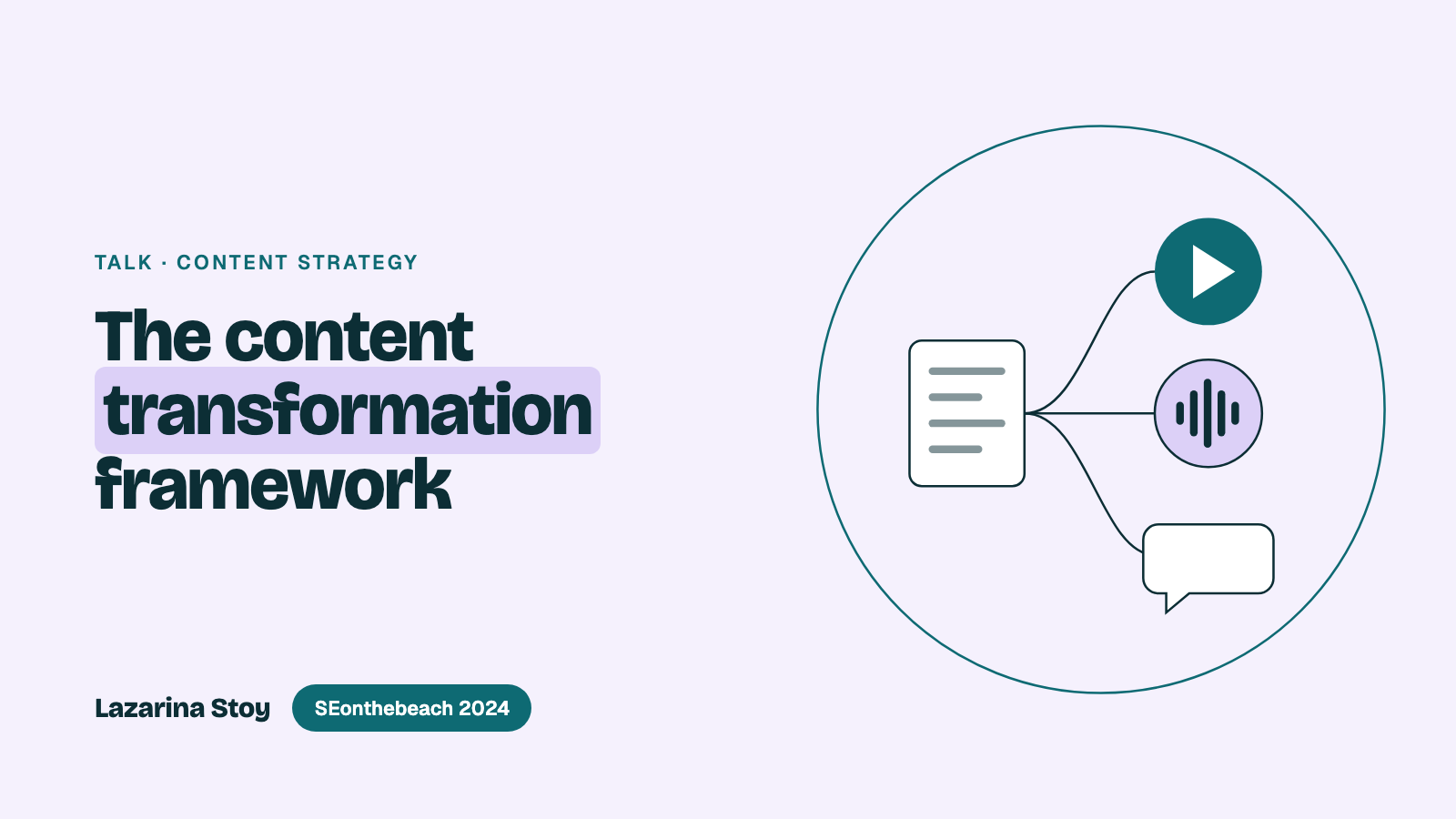
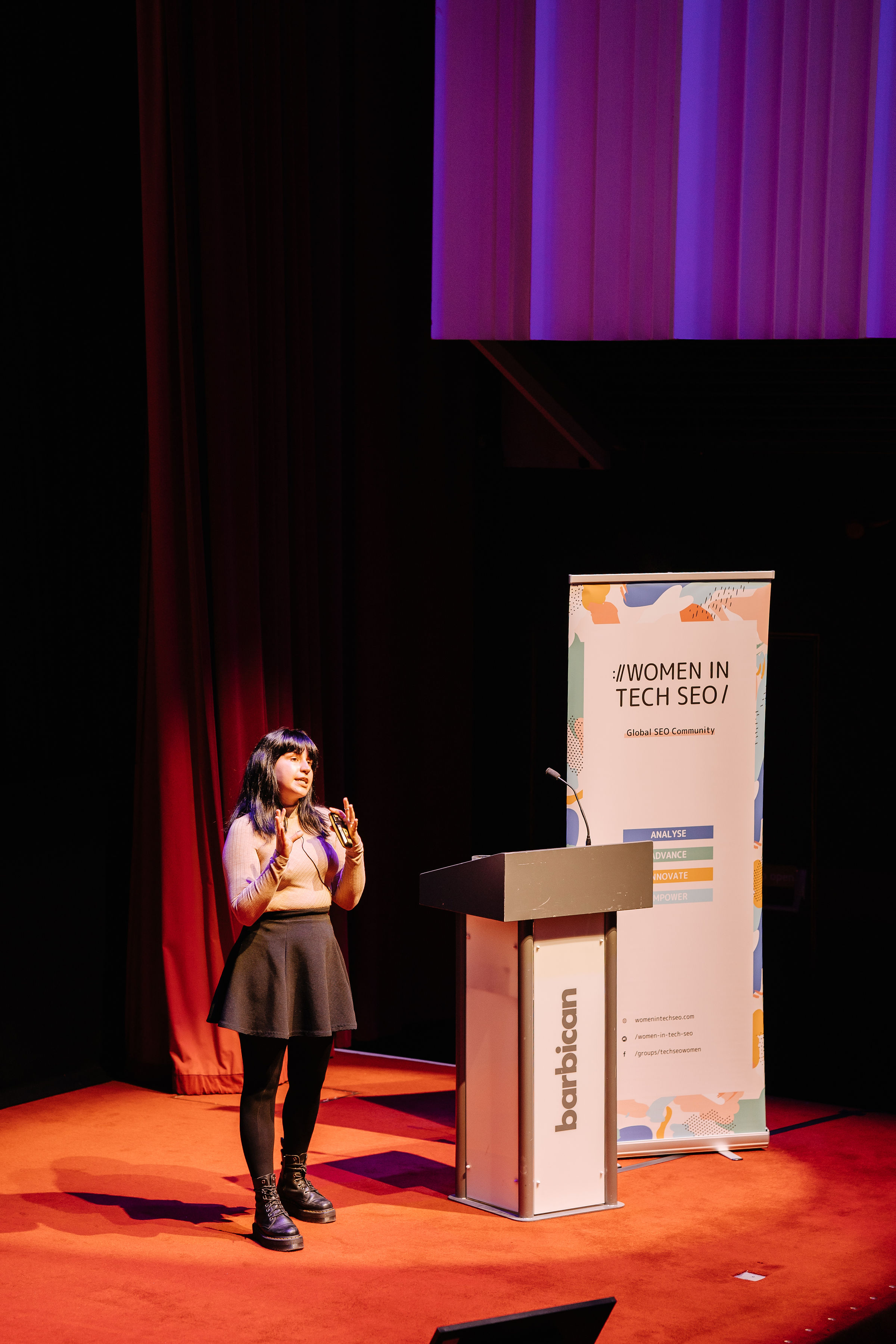
You spend weeks making one great piece of content, publish it as a blog post, share it once on LinkedIn and move on. In June 2024 I stood on a stage at SEonthebeach in Murcia and argued that this is the most expensive habit in content marketing, and that machine learning finally makes it cheap to break.
About this talk
- Event: SEonthebeach 2024
- City: Murcia, Spain
- Date: June 2024
- Slides: Content Transformation Framework of the Future (PDF)
SEonthebeach is the kind of conference where the audience has a beer in hand and the speaker’s main competitor is the sea. Earlier that day I’d listened to a talk about generating news with AI, and halfway through it I had a sudden rush of concern: are we the baddies? My whole talk was about automating content transformation. Was I about to stand up and teach a room of SEOs how to make the web worse, faster?
I don’t think so, and I said why on stage. The people in that audience know their users and know what good content looks like. If they don’t learn these tools, the only people using them at scale are the spammers. (They were already using them at scale in 2024. They still are.)
This write-up is the talk’s argument in full, rebuilt around the framework, which is the part I’d still defend today. I’ve updated it to October 2026, because a lot has changed. The tools I called “not there yet” have arrived, AI search has become a place your content needs to show up, and the rules about what you’re allowed to publish have become much more specific.
This article covers:
- why content has to work harder than it did, and why “what would Google think?” is the wrong first question
- the Content Transformation Framework, as seven steps you can map on one page
- the five transformation paths (video to text, long video to shorts, text to audio, text to video, text to text), with what I recommended in 2024 and what I’d use now
- what AI search surfaces change about the framework
- governance: where to draw the line before your brand ends up in the slop
Why content has to work harder now
My opening argument was simple. Search has changed, and not only on Google’s side.
We search on different platforms. The journey no longer starts and ends with a Google search box. In the deck I used HubSpot’s May 2023 Consumer Trends survey of 600+ US consumers: 88% used search engines to find answers online, 31% used social media and 12% already used AI chatbots like ChatGPT. Among Gen Z, 31% said they preferred searching on social media over search engines. People search inside TikTok, inside Reddit, inside a brand’s own site because they know its search works better than Google’s for that product.
We search on different devices. I borrowed Heather Physioc’s “Modern Search Path” slide because it shows the mess beautifully: one need can travel through a phone, a car or a smart speaker, into a voice assistant, an app or a marketplace, and come out as anything from a featured snippet to a chatbot reply.
We choose platforms based on intention and context. When I was planning what to wear for the talk, I went to Pinterest and Instagram. (I chose so well that I spent the talk with a loose string hanging off my dress.) When I have a work problem, I go to YouTube or Stack Overflow. Same person, same day, completely different platforms.
Search intent is rarely straightforward or explicit
This is where I took a swing at my own past. One of my first conference talks was about search intent classification, and on that beach I told the room we have intent wrong.
The book that changed my mind is Anthony Ulwick’s Jobs to Be Done: Theory to Practice. Its premise is that people think in tasks they want to get done, and a search is a very small part of that task. We label “best robot vacuum cleaner” as commercial or transactional. The person typing it is thinking: I want a clean house. And sometimes the implicit layer goes deeper still: I want a clean house because my mother-in-law is visiting and I don’t want to be judged.

If the job is “maintain a clean living space”, a single blog post targeting “best robot vacuum cleaner” covers a sliver of it. The person might want a cleaning routine video, a podcast about tidying while they actually tidy, or a Reddit thread from someone with three cats. Content that only exists in one format, on one platform, catches one micro-moment.
Relying on organic traffic alone is no longer a viable strategy
Add an industry split into separate rooms (SEO, content, social, paid) and you get the problem I wanted to solve: brilliant, expensive content sitting in one format on one channel.
So the goal I put on screen was not “more traffic”. It was omnipresence. Brand content needs to be:
- available in multiple formats
- available on multiple platforms
- accessible at multiple micro-moments through the day
- accessible to a global audience
- connected, so the signals from each platform point back to the same brand
That last one matters because no platform will join the dots for you. Google doesn’t neatly connect your YouTube channel, LinkedIn posts and blog into one picture of your brand. You have to.
Since I gave this talk, the case has only got stronger. Google’s AI Overviews and AI Mode, ChatGPT and Perplexity now answer many questions before anyone clicks, and they cite video, forums and social posts as well as web pages. I’ll come back to this, because it changes one step of the framework.
“What would Google think about this?” is the wrong first question
Every time I talk about repurposing, someone asks about duplicate content. If my video says the same thing as my blog post, will Google mind?
My answer on stage: stop asking what Google would think, and ask what people would think. (Yes, I know I sound like a Google spokesperson. Google consistently disappointed us with traffic that year, so I said it through gritted teeth.)
For the record, Google has addressed this directly. In a January 2021 Search Central office-hours session, John Mueller said Google doesn’t run text analysis on videos and map them to web pages, and that a video with the same content as a blog post is still something different, because people sometimes come to read and sometimes come to watch or listen.
First of all we don’t do text analysis of the videos and then map them to web pages. If your video has the same content as your blog post it’s still something different.
— John Mueller, Google Search Central office hours, January 2021
That matches what we know about users. Their content choices are shaped by three things: their context (are they on a train with no headphones?), their information need, and their pre-existing knowledge of the topic. Think of every time you wanted to watch a short video but couldn’t, because playing the audio would have been socially unacceptable where you were. A transcript or a written version isn’t duplication. It’s access.
Olaf Kopp’s content funnel, which I also showed, maps dozens of content types to each stage from pre-awareness to loyalty. The more of those micro-moments you capture, the more often you appear without having to sell.
Which leads to the obvious problem: nobody has the budget to produce every piece natively in every format. That’s what the framework is for.
The Content Transformation Framework
The framework is the part of the talk I’d keep even if every tool in it changed, and most of them have. It’s a planning exercise you do before you write any code or buy any tool. Here it is as seven steps, updated for 2026.
Picture it as a hub and spokes. In the middle sits one source asset: a long video, a webinar, a strong blog post, a research report. Around it are the derived formats (article, short video, audio, social post, forum contribution, newsletter, AI-ready answer chunks). Each spoke ends at the platforms where your audience meets that format. Running around the outside is a ring that holds it all together: human review, governance and connected signals. The steps below are how you draw that diagram for your own brand.
| — | — | — |
|---|---|---|
| 1. Start from the audience | Who is this for, and what job are they trying to get done? | Audience and jobs-to-be-done map |
| 2. Inventory your source assets | What do we already have that only lives in one format? | Source asset list, ranked by value |
| 3. Map the transformation paths | Which formats and platforms does each source become? | One “turn into → presence on” map per source type |
| 4. Design the source for transformation | How do we create the original so it splits well? | Production brief |
| 5. Choose a method per path | No-code, programmatic, or a model that does both? | Tooling decision per path |
| 6. Keep a human and a policy in the loop | Who checks it, what do we disclose, what do we never automate? | Editorial and governance rules |
| 7. Connect and measure presence | Do the platforms point back to one brand, and are we showing up? | Connected profiles and a presence dashboard |
1. Start from the audience, not the asset
Before anything technical, I asked the room to think about their ideal audience and their extended circle: the people around them who’d also find the information useful. Then:
- Where are they? Which platforms do they actually use, for which jobs?
- How do they want to be spoken to? The tone that works on LinkedIn will get you laughed off Reddit.
- Which formats do they want, not only for branded content but for entertainment and education?
- Which micro-moments are you missing? Commuting, cooking, cleaning, a quick look between meetings.
Skip this and you’ll transform content into formats nobody wants, which is just a more efficient way to waste money.
2. Inventory your source assets
Next, list the content you’re not fully capitalising on. The best sources are usually expensive things that live in only one place: conference talks and keynotes, webinars, customer interviews, podcast episodes, long-form guides, PDF reports, user research and documentation.
The case study I shared on stage still makes me wince. A large big-tech organisation I worked with ran an annual event that absorbed resources across the company for about two months. Senior executives and experts poured their know-how into a two-day conference. Afterwards, all of it lived as two-hour keynote recordings on YouTube, and nowhere else.
We transcribed those recordings and turned them into blog posts on the company’s site. The cost was API fees (negligible) plus the experts’ time to review the drafts, which is the content editing every blog post needs anyway. Two months of expertise went from “buried in a video” to “searchable, linkable and quotable”.
3. Map the transformation paths
This is the step I called “map out your content transformation framework”, and it’s the heart of it. For each type of source asset, write down what it turns into and where each format will live. I showed two starting points.
Starting from a blog post, you can turn it into a video, short videos, audio, social posts and forum posts.

Starting from a video, the path runs the other way: the video becomes a blog post (which reaches Google, Bing and every other web search engine), audio and short video, and those in turn become social and forum posts.

I described these on stage as “an extremely simplified version” of what you’d map for a real brand, and that’s still true. For each source, decide: is the starting video one hour long or three parts? Is the blog post going to feed socials, YouTube, or both? Which ones are worth it for this audience? Once the map exists, you know exactly which machine learning models you need, and you stop buying tools for problems you don’t have.
What I’d add in 2026: a column for AI answer surfaces. AI Overviews, AI Mode, ChatGPT and Perplexity don’t consume your content as a page. They retrieve passages, and they cite video transcripts, forum threads and articles side by side. So one of the “formats” on your map is now the self-contained, quotable chunk. I’ve written about this on MLforSEO: the chunk, not the page.
4. Design the source for transformation
This came from a question I put to the audience about automated clipping tools: what can go wrong if you feed a long talking-head video into one and publish everything it spits out?
A lot. If the original wasn’t built to be split, the clips are disjointed and dull, and a feed full of them can genuinely alienate your audience on social. The fix happens upstream. If you know a video will become shorts, record it so each segment works on its own: one point per segment, a hook at the start of each, nothing that depends on “as I said earlier”.
In 2026 I’d apply the same rule to text. If an article will be chopped into social posts, newsletter sections and AI-retrievable passages, write sections that stand on their own, open with the answer, and name the thing they’re about instead of saying “this” or “it”.
5. Choose a method per path
For every path, I compared two approaches:
| — | — | — |
|---|---|---|
| No-code tools | Beginners, non-technical teams | Limited scalability: you process items one by one |
| Programmatic (APIs, scripts) | Intermediate, API-savvy teams | Time and adoption costs: learning and developer resources |
That trade-off hasn’t changed. What has changed is that most good models now sit behind both a friendly interface and an API, so you can prototype a path no-code and script it once it’s proven.
6. Keep a human and a policy in the loop
In 2024 this was a closing warning. In 2026 it’s a step in its own right, with real rules behind it. I’ll cover it properly in the governance section below. The short version: every transformed piece gets a human editor, you decide in advance what you disclose, and some things you never fully automate.
7. Connect and measure presence
Finally, connect the signals. Use the same brand and author names everywhere, link your profiles to each other and back to your site, and link each derived piece to its source (the article embeds the video, the video description links the article, the social post credits the report).
Then measure presence, not just sessions. The end goal I gave on stage was being in the consumer’s mind whenever they have a problem you can solve. Today that means tracking where you appear (YouTube search, social search, forum threads, AI answers and citations) alongside clicks.
The five transformation paths, updated for 2026
Here’s what I recommended in June 2024 for each path, and what I’d do now. Treat every tool name as a snapshot.
Path 1: Video to text (speech-to-text)
The 2024 use case: you have a library of videos on YouTube but no blog, or no written version of your best talks. Speech-to-text has been around for a long time and is the easiest path to automate.
What I showed: no-code tools like Descript (which I use) and Happy Scribe for small jobs, and for anything at scale, Google Cloud Speech-to-Text, Amazon Transcribe or OpenAI’s Whisper. The programmatic pipeline had three steps: download the videos (or a public playlist or channel) and organise the files, convert video to audio to reduce the load, then transcribe. All three APIs added punctuation automatically, coped with uncommon words, and handled speakers switching languages (English to Spanish, say). At the time, Google’s and Amazon’s APIs had more advanced features than OpenAI’s, such as speaker diarisation, profanity and toxic content detection, and noise robustness.
Since I gave this talk: all three providers have moved on, and this is the path where my 2024 comparison has aged the most. Feature gaps have mostly closed:
- OpenAI released gpt-4o-transcribe and gpt-4o-mini-transcribe in March 2025, then added speaker labels with gpt-4o-transcribe-diarize in October 2025. In July 2026 it launched gpt-transcribe and gpt-live-transcribe, and its deprecations page says Whisper-1 and the gpt-4o transcription models will be removed in February 2027. If you built on Whisper, plan the migration now.
- Google Cloud’s Chirp 3 speech-to-text model became generally available in October 2025, with speaker diarisation, automatic language detection and a built-in denoiser.
- Amazon Transcribe now lists speaker diarisation, automatic language identification (including several languages in one file), toxicity detection, PII redaction and generative AI call summaries.
How I’d do it now: transcription is the cheap part. The value is in what happens after: speaker labels, timestamps, then an LLM pass that turns a rambling transcript into a structured draft an expert can approve in minutes. If you want to build the transcription step yourself, I have a free tutorial on MLforSEO for transcribing audio with the Whisper API in Google Colab. And never publish a raw transcript as a “blog post”. Keep the editor in place, which in my case study was the expert who gave the talk.
Path 2: Long-form video to shorts
The 2024 use case: you have long videos and want presence on YouTube Shorts, TikTok and Reels.
What I showed: clipping tools such as OpusClip, which ingest a long video and return a batch of captioned short clips. I was clear that this is just one of many tools for the job, and that custom solutions can (and should) be built for bigger libraries and bulk editing.
Since I gave this talk: OpusClip and its competitors are still going strong, and clipping is now built into most editing tools. The bigger change is on the platform side. In July 2025 YouTube renamed its “repetitious content” monetisation policy to “inauthentic content”, explicitly covering mass-produced, template-based videos, including AI-generated content made with generic or unoriginal templates. A channel that’s nothing but auto-clipped fragments is exactly what that policy is written for.
How I’d do it now: use clipping tools to find candidate moments, then have a human pick, trim and caption the ones that genuinely stand alone. Step 4 of the framework does most of the work here.
Path 3: Text to audio (text-to-speech)
The 2024 use case: you have high-performing blog posts or interviews suitable for audio platforms, and you want them available to people who are driving, cooking or cleaning.
What I showed: the programmatic options were Google Cloud Text-to-Speech and Amazon Polly, with OpenAI’s GPT-4o voice “coming soon”. The APIs let you select a language, a voice and a dialect, and process text files in bulk. I said this works well for static formats that don’t need much character, like written interviews your users submit, and becomes dystopian when there’s no human involved at all: ChatGPT-written articles piped straight into a robot voice. A lot of content was already like that.
Since I gave this talk: voices have become steerable, and that changes what’s possible.
- OpenAI’s gpt-4o-mini-tts (March 2025) can be instructed on how to speak, not just what to say.
- Google added Chirp 3 HD voices to Cloud Text-to-Speech in April 2025, and Gemini TTS models in September 2025, with multi-speaker output and style you steer with a prompt.
- Amazon Polly launched a generative voice engine in May 2024 and has kept adding voices, plus bidirectional streaming in March 2026.
- The format I didn’t see coming was the AI-hosted conversation. NotebookLM’s Audio Overviews (September 2024) turn your documents into a two-host “deep dive”, and in June 2025 Google started testing Audio Overviews in Search in Labs. Google itself is now transforming text into audio for searchers.
How I’d do it now: narrated versions of your best evergreen articles, audio summaries of reports, and accessible versions of interview content are all reasonable. A fully synthetic podcast “hosted” by voices that pretend to be people is not something I’d put a brand’s name on without clear disclosure.
Path 4: Text to video
The 2024 verdict: “Truthfully, we are not there yet.” I showed early text-to-video tools and OpenAI’s Sora preview, which hadn’t been released. My view was that this software could supplement a person-to-camera set-up but not replace it. The one creative use I recommended was animating something static that nobody would ever invest in filming, like knowledge-base documentation or a short tutorial, so it could at least exist on YouTube.
Since I gave this talk: a lot, and some of it already came and went.
- Google announced Veo 3 and its Flow filmmaking tool at I/O in May 2025. Veo 3 generates sound effects, ambient noise and dialogue natively, and Veo 3.1 (October 2025) brought richer audio. By then Flow had been used to generate more than 275 million videos.
- OpenAI launched Sora 2 with synced audio in September 2025. Then, per OpenAI’s own deprecations page, the Sora 2 models and the Videos API were removed from the API in September 2026. Which is a useful reminder: never build a content pipeline that depends on one vendor’s one model.
- NotebookLM added Video Overviews in July 2025: narrated visual explainers generated from your documents. That’s very close to the “turn the knowledge base into a short video” use case I suggested in 2024.
How I’d do it now: I’ll revise my verdict. Technically, we’re much closer. For b-roll, illustrative scenes, product explainers and turning documentation into short walk-throughs, generated video is now genuinely useful. For branded content where trust matters, a real person on camera still wins, and anything realistic you generate now comes with disclosure obligations (see governance below).
Path 5: Text to text
The 2024 use case: you have high-performing blog posts but no distribution, so you turn them into social posts. Or you have posts but no newsletter, so you have an LLM draft newsletter editions. Or you have long guides and PDF reports, so you extract key insights, summaries and tips and turn them into articles, threads and posts.
What I showed: at the no-code end, ChatGPT and custom GPTs. (I also said most of the web tools were wrappers around GPT and not worth paying for. I stand by that.) Programmatically, GPT-4/GPT-4o, Vertex AI or any other LLM. My bottom line was: overall, any LLM would do a great job here; prompting it well, with plenty of examples, is the key to a great result. Know the guidelines and norms of the platform you’re writing for and build them into the prompt.
Since I gave this talk: the “any LLM” point is even more true. The differences between frontier models matter far less for repurposing than your examples, your brand voice guide and your review process. Two things have changed in what you’re transforming into:
- Forum and community content. Reddit’s visibility in Google grew so much that it became its own talking point. Google announced an expanded partnership with Reddit in February 2024, including access to Reddit’s Data API, and OpenAI followed in May 2024. Forum threads are now a major source for AI answers too (more on that below). The temptation is to generate forum posts. Don’t. Communities detect it fast and moderators remove it. Transform your insights into genuinely useful answers, posted by real people who participate.
- AI-ready passages. Summaries, definitions, comparison tables and FAQs that work as standalone answers are now a transformation target in their own right.
What AI search changes about the framework
When I gave this talk, Google had only just rolled out AI Overviews in the US, a few weeks earlier. Since then, Google has said AI Overviews reach over 2 billion monthly users (July 2025), AI Mode launched in the US in May 2025 and now has over one billion monthly users, and ChatGPT, which launched search in October 2024, reported 900 million weekly users in February 2026. The framework didn’t need a rewrite, but AI search changed three things.
1. AI surfaces are a platform on your map. They’re a place your content is “present”, even when nobody clicks, and they lean heavily on exactly the formats this framework produces. Ahrefs’ September 2026 analysis of 3M+ US queries found that among the top 50 sources cited in AI Overviews, YouTube had a 22.9% mention share and Reddit 18.5%. In AI Mode the two were neck and neck (17.9% and 17.8%). Other studies (from Profound and Semrush, for example) count citations differently, so the percentages don’t compare directly, but the direction is consistent: if your expertise only exists as a blog post, you’re absent from a big share of the sources these systems prefer.
2. Multimodal is no longer a nice-to-have. In October 2024 Google said Lens handled nearly 20 billion visual searches every month, and in September 2025 Search Live let everyone in the US talk to AI Mode and point their camera at things. People now search by speaking, pointing and asking follow-ups. Your images, videos and audio need text around them (transcripts, captions, descriptive alt text, structured data) so both people and machines can understand them. My MLforSEO guide to image SEO and multimodal search goes deep on this, and the YouTube SEO guide covers the video side.
3. There are no special tricks. Google’s own AI features documentation says there are no additional requirements to appear in AI Overviews or AI Mode, and its July 2026 guide to generative AI features warns against artificially chunking content or rewriting pages for AI. That’s an important caveat to my “chunk” point above: write sections that stand on their own because that’s good writing for every format, not because you’re slicing pages up for a machine. Good transformation is good SEO: helpful, original, well-structured content in the formats people want.
If you want to know which formats your audience’s queries already reward, I built a free lab notebook for identifying desired content formats and platforms from SERP data. It’s a quick, data-backed way to do step 3.
Governance: know where to draw the line
My bottom line in Murcia had three parts. Do what makes sense for your brand and audience. Embrace automation for process enhancement and for platform enablement. But know where to draw the line before things become… and then I put up a picture of a shrimp-Jesus-style AI image, the kind that was flooding Facebook (my mum’s Facebook in particular, for reasons I still don’t understand). If you know, you know. You don’t want your branded content to give people that vibe.
There’s no system that, once nailed, lets you walk off to the beach and leave the laptop to do the job. Adopt the tools as far as they save time and give you better insight (transcribing competitors’ YouTube videos to analyse their strategy, say). Don’t let them produce anything that feels like slop.
Since I gave this talk, “don’t make slop” has turned into actual policy:
- Google’s spam policies. With the March 2024 core update, announced three months before my talk, Google introduced a “scaled content abuse” policy. It targets unoriginal content produced at scale no matter how it’s created, and its examples include using generative AI tools to generate many pages without adding value. Google’s AI content guidance still says it rewards quality regardless of how content is produced. Both are true at once: the method isn’t the problem, the lack of added value is.
- Quality raters. The January 2025 update to Google’s Search Quality Rater Guidelines added a definition of generative AI and, as Search Engine Land reported, tells raters to give the Lowest rating to pages whose main content is all or nearly all AI-generated with little added value.
- YouTube. Since March 2024, creators must disclose realistic altered or synthetic content. Using AI for scripts, ideas or captions doesn’t need disclosure. And since July 2025, mass-produced, templated content is “inauthentic content” for monetisation purposes.
- The EU AI Act. Article 50 has applied since 2 August 2026. Deepfakes must be disclosed, and so must AI-generated text published to inform the public on matters of public interest, unless it has undergone human review or editorial control. In June 2026 the Commission published a voluntary Code of Practice on marking and labelling AI-generated content. Notice the editorial-control exemption: a human editor isn’t just good practice, it changes your obligations. (I’m not a lawyer, so check with one if you publish to EU audiences at scale.)
- Provenance. Google joined the C2PA steering committee in 2024 and surfaces C2PA metadata in “About this image”. YouTube shows a “captured with a camera” label for unedited footage recorded on C2PA-capable devices, and Google’s SynthID Detector checks for its watermark in content made with its own models.
My governance checklist for transformed content
- A named human editor signs off every published piece, ideally the subject expert. Transformation saves the writing time, not the review time.
- Add something in every transformation. A transcript-based article should gain structure, links, examples and context. If a derived piece adds nothing for the person on that platform, don’t publish it.
- Decide your disclosure rules in advance: synthetic voices, generated video, AI-generated images of realistic people or events. Follow each platform’s labelling rules and the law where your audience is.
- Never fully automate high-trust content: anything medical, financial, legal, or presented as a real person speaking.
- Check facts, names and numbers against the source. Speech-to-text mishears names; LLMs “improve” statistics.
- Respect platform norms, especially communities. Participate, don’t broadcast.
- Keep provenance: store the source, the prompt or settings, the model and the editor for each piece, so you can fix or withdraw it later.
The bottom line, two years on
I ended the talk on mindset, community and resources. Learning machine learning has been the most transformational thing I’ve done in my life, and I started before I even got into SEO. It’s mostly about being willing to fail constantly, to shout at your computer, then at the algorithms, then at Google. SEOs already have that bit nailed.
It was also the first time I talked publicly about MLforSEO, which I was building at the time as a home for code, resources and a newsletter for SEOs learning machine learning. It’s grown a lot since that beach.
If you want to build the paths in this framework yourself, the Introduction to Machine Learning for SEO course in the MLforSEO Academy has a module on content transformation, with the theory, the different transformation types and templates to implement them.
Your next steps:
- Pick one high-value source asset that only exists in one format.
- Write down the audience’s job to be done and the three platforms where they’d want this content.
- Draw its “turn into → presence on” map, including an AI answers column.
- Choose one path and run it with a human editor in the loop.
- Measure presence on those platforms for a month before you scale.
The slides are here. There’s also a recording of the talk on YouTube, though honestly, this write-up is the better version.
Want me to give this talk at your event? Book me to speak.
Frequently asked questions
What is a content transformation framework?
A content transformation framework is a plan for turning one source asset, such as a video, webinar or long article, into several formats (articles, short videos, audio, social and forum posts, AI-ready passages) and mapping each format to the platforms where your audience will find it. It’s done before choosing tools, so you only automate the paths that are worth it.
Is repurposing a blog post into a video duplicate content?
No. Google has said it doesn’t map video content to web pages as duplicates, and a video serves people who want to watch or listen rather than read. Duplication becomes a problem when you republish near-identical text across many pages, not when you change the format.
Can I fully automate content repurposing with AI?
You can automate most of the production work (transcription, clipping, drafting, narration), but you shouldn’t automate publishing. Mass-producing low-value pages violates Google’s scaled content abuse policy, and platforms like YouTube have their own rules on repetitive and synthetic content. Keep a human editor and add value in every transformation.
Which transformation path should I start with?
Start with the one that unlocks the most existing value for the least effort. For most brands that’s video to text, because speech-to-text is cheap and accurate, and talks or webinars that only live on YouTube become searchable articles. Text to social posts is a close second.
Written by Lazarina Stoy
Organic growth and AI automation consultant, speaker, and founder of MLforSEO and Data Studio for Marketers. I help marketing teams use AI and automation in ways that are practical, sustainable and scalable.